
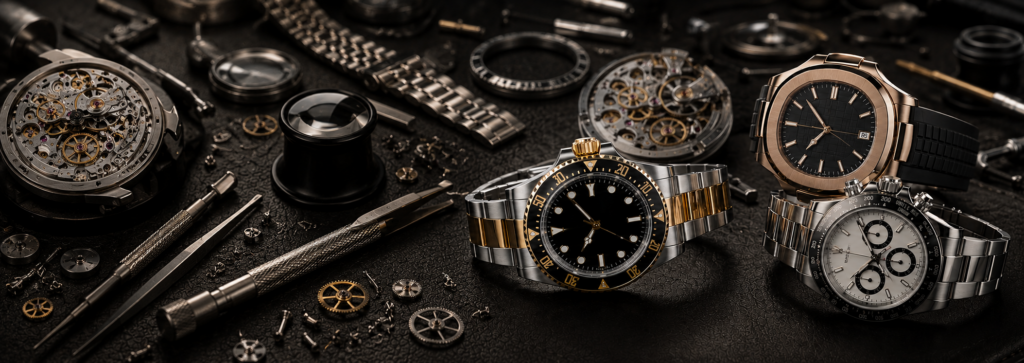
Water inside a watch can quickly turn from a small concern into a much larger problem. If you notice condensation underneath the crystal, your watch stopped working after getting wet, or your timepiece was accidentally submerged, having it inspected as soon as possible can help determine the extent of the damage.
If you’re searching for water-damaged watch repair in San Antonio, SPEEDY WATCH provides a professional place to bring your watch for evaluation.
Water and moisture can potentially affect the movement, dial, hands, seals, electronic components, and other parts inside a watch. Even watches designed with water resistance aren’t necessarily protected from every type of water exposure.
At SPEEDY WATCH, we help San Antonio watch owners evaluate watches that have been exposed to water and determine what type of repair or service may be appropriate.
Whether you own an everyday quartz watch, automatic watch, mechanical watch, vintage timepiece, or luxury watch, don’t ignore signs of moisture inside the case.
What Happens When Water Gets Inside a Watch?
The exterior of a watch is designed to help protect its internal components.
Depending on the watch, seals and gaskets may be positioned around areas such as the caseback, crown, crystal, and pushers.
If moisture gets past those protective areas, it can enter the watch case.
Once inside, water can potentially come into contact with components that were not designed for prolonged moisture exposure.
These can include:
Watch movement
Dial
Hands
Gears
Springs
Electronic components
Battery compartment
Metal components
Lubricants
Water doesn’t necessarily damage every watch in exactly the same way. The extent of the problem can depend on how much water entered, how long it remained inside, the type of movement, the watch’s construction, and its existing condition.
That’s why an inspection is important.
Signs Your Watch May Have Water Damage
Sometimes water damage is obvious.
Other times, the first signs can be relatively subtle.
Consider having your watch inspected if you notice:
Condensation underneath the crystal
Fogging inside the watch
Visible water droplets beneath the crystal
The watch stopped after getting wet
The watch began running differently after water exposure
The dial appears discolored
The hands show unusual marks or discoloration
The crown was open or unscrewed during water exposure
The crystal is cracked
The watch was submerged unexpectedly
The watch was exposed to significant moisture
Even if the watch continues operating, visible moisture inside the case is worth taking seriously.
Why Is My Watch Fogging Up Inside?
Fogging underneath the crystal is one of the clearest indications that moisture may be present inside the watch.
You may notice the crystal become cloudy after moving between different temperatures or after the watch is exposed to water.
If condensation is appearing inside the crystal rather than on the exterior surface, moisture may have entered the case.
The moisture may later disappear from view, but that doesn’t necessarily mean the interior is completely dry or that no damage occurred.
If you repeatedly see condensation underneath your watch crystal, consider having the watch inspected.
What Should I Do if Water Gets Inside My Watch?
If you believe water has entered your watch, avoid assuming that waiting for it to dry will solve the problem.
You should consider having the watch evaluated promptly.
Depending on the watch and circumstances, continued operation while moisture is present could potentially contribute to additional problems.
If possible, remember what happened before bringing the watch in.
Useful information can include:
When the water exposure occurred
Whether the watch was completely submerged
Whether it was fresh water, salt water, or another liquid
Approximately how long the watch was exposed
Whether the crown was open
Whether the watch continued operating afterward
When condensation first appeared
This information can help provide context during the evaluation.
Can a Water-Damaged Watch Be Repaired?
Possibly.
Whether a water-damaged watch can be repaired depends on the condition of the watch and the extent of the damage.
A watch that experienced minor moisture exposure and was addressed quickly may present a very different situation from a watch that has been sitting with internal corrosion for months or years.
Potential considerations can include:
Movement condition
Corrosion
Dial condition
Hand condition
Battery condition
Electronic component condition
Gasket condition
Crown condition
Crystal condition
Availability of replacement components
The watch needs to be inspected before determining what type of repair may be appropriate.
Why Water Damage Can Become Worse Over Time
One concern with water inside a watch is corrosion.
Watch movements can contain numerous small metal components.
When moisture remains inside the case, certain metal parts may begin to oxidize or corrode.
Corrosion can potentially affect the operation of components and make a repair more complicated.
Moisture may also affect the appearance of a dial or hands.
This is particularly important with vintage and collectible watches because original dials and hands can contribute significantly to the character and desirability of a timepiece.
Addressing moisture sooner can help you understand the situation before additional deterioration occurs.
Water Damage in Quartz Watches
Quartz watches use electronic movements that are commonly powered by batteries.
If water gets inside a quartz watch, moisture can potentially affect the movement, battery compartment, contacts, and other electronic components.
If your quartz watch stops after getting wet, don’t automatically assume it simply needs a new battery.
Replacing the battery without addressing moisture or corrosion may not solve the underlying problem.
The watch should first be evaluated to determine what may have happened internally.
Water Damage in Automatic Watches
Automatic watches use mechanical movements containing numerous small components.
If moisture enters an automatic watch, it can potentially affect gears, springs, screws, bearings, lubricants, and other movement components.
The watch may continue operating initially even though moisture is present.
Later, you might notice changes in accuracy, power reserve, winding, or overall performance.
If your automatic watch has been exposed to water and begins behaving differently, consider having it inspected.
Water Damage in Mechanical Watches
Traditional mechanical watches are also vulnerable to moisture.
These movements depend on precise interaction between small mechanical components.
Corrosion or contamination can interfere with that operation.
If you own a vintage mechanical watch, water exposure can be particularly concerning because certain replacement components may be difficult to obtain.
Preserving original components can also matter for collectible watches.
Water Damage in Luxury Watches
A luxury watch can represent a significant financial investment.
If water enters a Rolex, Omega, Cartier, Breitling, TAG Heuer, Tudor, Patek Philippe, Audemars Piguet, or another luxury timepiece, prompt evaluation can be especially important.
Luxury watches can contain valuable movements, dials, hands, bezels, crowns, and other components.
The objective shouldn’t simply be getting the watch running again.
Its overall condition should also be considered.
If the watch is vintage or collectible, decisions involving replacement components, dial restoration, hand replacement, or polishing should be made carefully.
Water Damage in a Rolex Watch
Many Rolex watches are designed with water resistance in mind, but that doesn’t mean water can never enter a Rolex.
Water resistance depends on the condition and proper function of multiple components.
Depending on the model, these can include seals associated with the crown, caseback, crystal, and other areas.
Age, damage, worn components, an improperly secured crown, or previous work on the watch can potentially affect its ability to resist water.
If you see condensation underneath your Rolex crystal, consider having the watch inspected rather than continuing to wear it normally.
Water inside a valuable mechanical watch deserves attention.
Is a Waterproof Watch Really Waterproof?
The word waterproof can create confusion.
Modern watches are typically described in terms of water resistance rather than as being permanently waterproof.
A water-resistance rating doesn’t mean a watch is protected against every possible situation forever.
Resistance can be affected by:
Age
Gasket condition
Crown condition
Crystal condition
Case condition
Previous repairs
Impacts
Temperature changes
Whether the crown is properly secured
Maintenance history
A watch that met a particular specification when new may require maintenance and testing to confirm its current condition.
What Do Water-Resistance Ratings Mean?
Watch dials and casebacks may display ratings such as meters, feet, ATM, or bar.
These ratings relate to standardized pressure testing and shouldn’t automatically be interpreted as a simple statement that a watch can be used at the displayed depth in every real-world situation.
The actual appropriate use of a watch depends on its manufacturer guidance, design, condition, and current water resistance.
If water exposure is important to how you use your watch, consult the manufacturer’s recommendations for your specific model.
What Is a Watch Gasket?
Gaskets are sealing components that help protect the interior of a watch.
Depending on the watch, gaskets may be used around the:
Caseback
Crown
Crystal
Pushers
Other openings
Like many materials, gaskets can deteriorate over time.
Heat, age, repeated opening of the watch, environmental exposure, and other factors may affect their condition.
A deteriorated gasket can potentially reduce the protection provided against moisture.
Can Changing a Watch Battery Affect Water Resistance?
Opening a watch for battery replacement means accessing the interior through the case.
Afterward, the watch needs to be properly closed.
The condition and placement of the caseback gasket may also matter.
A battery replacement by itself doesn’t guarantee that a watch continues to meet its original water-resistance specification.
If maintaining water resistance is important, ask whether appropriate inspection and testing are available for your particular watch.
Can a Cracked Watch Crystal Cause Water Damage?
A damaged crystal can potentially compromise part of the watch’s exterior protection.
A significant crack, chip, or improperly fitted crystal may create a possible entry point for moisture or debris.
If your watch has a cracked crystal, consider having it inspected before exposing the watch to water.
Replacing a severely damaged crystal may help protect the dial and internal components from further exposure.
Can a Damaged Crown Let Water Into a Watch?
Potentially.
The crown is another important area of a watch case.
Certain watches use specialized crown systems and gaskets to help provide water resistance.
If the crown is damaged, loose, improperly secured, or missing, water resistance may be compromised.
If your watch has a screw-down crown, make sure it is properly secured according to the manufacturer’s instructions before water exposure.
If the crown doesn’t operate normally, consider having it inspected.
Can I Dry a Water-Damaged Watch at Home?
Home remedies shouldn’t be treated as substitutes for a professional inspection.
Placing a watch in rice, using a hair dryer, leaving it in direct sunlight, or attempting to open it without appropriate tools may not address moisture trapped inside the movement.
Excessive heat could also potentially cause additional problems depending on the watch and materials.
The fact that visible condensation disappears doesn’t necessarily prove that the movement and internal components are dry and unaffected.
If the watch is important to you, have it evaluated.
Should I Keep Wearing a Water-Damaged Watch?
If you know or strongly suspect that water is inside your watch, consider having it inspected before continuing normal use.
This is especially important if the watch has:
Visible condensation
Stopped working
Changed its timekeeping behavior
Developed dial discoloration
Been submerged
Experienced saltwater exposure
A damaged crown or crystal
Continuing to use the watch doesn’t address the underlying moisture.
Saltwater vs. Freshwater Watch Damage
Not all water exposure is identical.
Saltwater can be particularly concerning because salts and other contaminants may remain after the water itself evaporates.
If your watch has been submerged in the ocean or exposed to saltwater, tell the person evaluating it.
The type of exposure can be useful information when assessing the watch.
Can Showering Damage a Watch?
Whether a particular watch is appropriate for showering depends on the watch and manufacturer recommendations.
Water resistance isn’t the only consideration.
Temperature changes, soaps, shampoos, chemicals, steam, seals, and the current condition of the watch can all be relevant.
Rather than assuming a water-resistant watch is automatically suitable for every shower or hot-water environment, follow the manufacturer’s recommendations for the specific model.
Can Swimming Damage a Watch?
A watch designed and currently maintained for appropriate water exposure may be suitable for certain swimming activities, depending on its specifications and manufacturer recommendations.
However, don’t assume that an older watch still has the same level of water resistance it had when new.
If you regularly swim with an important or valuable watch, periodic inspection and appropriate water-resistance testing can be worth considering.
What Happens During Water-Damaged Watch Repair?
The exact process depends on the watch and the severity of the damage.
The first step is evaluation.
The watch may need to be opened and inspected for signs of moisture, corrosion, contamination, or damaged components.
Depending on what is discovered, potential work could involve:
Drying appropriate components
Movement inspection
Cleaning
Corrosion assessment
Component replacement
Movement service or repair
Battery replacement when applicable
Gasket replacement
Crystal-related repair
Crown-related repair
Reassembly
Testing
Not every water-damaged watch requires the same repair.
The appropriate solution can only be determined after understanding what happened inside the watch.
How Much Does Water-Damaged Watch Repair Cost in San Antonio?
There isn’t one standard price because the extent of water damage can vary dramatically.
A watch addressed soon after limited moisture exposure could require very different work from a watch with significant movement corrosion.
Factors that can influence repair costs include:
Watch brand
Watch model
Movement type
Extent of water exposure
Corrosion
Required components
Availability of parts
Movement condition
Dial and hand condition
Additional repair needs
The best starting point is to have the watch evaluated.
Is a Water-Damaged Watch Worth Repairing?
It depends on the watch.
Financial value is one consideration, but it isn’t the only one.
A watch may have:
Financial value
Collector value
Sentimental value
Family history
Personal significance
An inherited watch may be worth repairing even if the restoration isn’t financially justified by resale value alone.
For a valuable luxury watch, understanding the watch’s condition and potential value can also help determine whether repair makes sense.
Should I Repair or Sell a Water-Damaged Luxury Watch?
If a luxury watch has extensive water damage, you may want to understand both the potential repair cost and the watch’s value in its current condition.
A significant repair doesn’t automatically increase the resale value by more than the cost of the work.
Some watch buyers may also purchase luxury watches that aren’t currently running or that require repair.
At SPEEDY WATCH, we work with customers interested in both watch repair and selling watches.
If you’re unsure whether to repair or sell your timepiece, start by understanding its condition.
How Can I Help Prevent Water Damage?
There are several practical habits that may help protect your watch.
Follow the manufacturer’s water-resistance recommendations.
Keep screw-down crowns properly secured when applicable.
Don’t operate crowns or pushers underwater unless the manufacturer specifically indicates that the watch is designed for it.
Have damaged crystals or crowns inspected.
Consider gasket condition as the watch ages.
Have water resistance appropriately tested when water exposure is important to you.
Don’t assume an older watch retains its original water resistance indefinitely.
Most importantly, know your particular watch.
Different watches are designed for different environments.
Water-Damaged Watch Repair Near Me in San Antonio
If you’re searching “water-damaged watch repair near me” in San Antonio, bring your watch to SPEEDY WATCH for an evaluation.
You don’t need to determine the extent of the damage yourself.
Tell us what happened and what you’ve noticed.
Our process begins with three steps.
Bring Us Your Watch
Bring the water-exposed watch to SPEEDY WATCH.
If possible, tell us when the exposure happened and what type of water was involved.
Have the Watch Evaluated
The watch can be inspected to better understand whether moisture entered the case and what components may have been affected.
Review Your Options
Once there is a better understanding of the condition, you can review the available repair or service options and decide how you’d like to proceed.
Why Choose SPEEDY WATCH in San Antonio?
At SPEEDY WATCH, watches are our focus.
We’re building a destination where San Antonio watch owners can bring their timepieces for repair, service, maintenance, and evaluation.
Whether you have an everyday quartz watch, an automatic watch, a mechanical timepiece, a vintage watch, or a luxury watch, our goal is to provide a straightforward experience.
You don’t have to know exactly what’s wrong with your watch.
Bring it in and let us help determine the next step.
Visit SPEEDY WATCH for Water-Damaged Watch Repair in San Antonio
Water inside a watch shouldn’t be ignored.
If you see condensation underneath the crystal, your watch stopped after getting wet, or you know the watch was submerged, consider having it inspected promptly.
The sooner you understand what’s happening inside the watch, the sooner you can make an informed decision about repair.
For water-damaged watch repair in San Antonio, TX, visit SPEEDY WATCH.
Bring us your watch and let us take a look.
SPEEDY WATCH
San Antonio, Texas
Watch Repair • Watch Service • Water-Damaged Watches • Luxury Watches